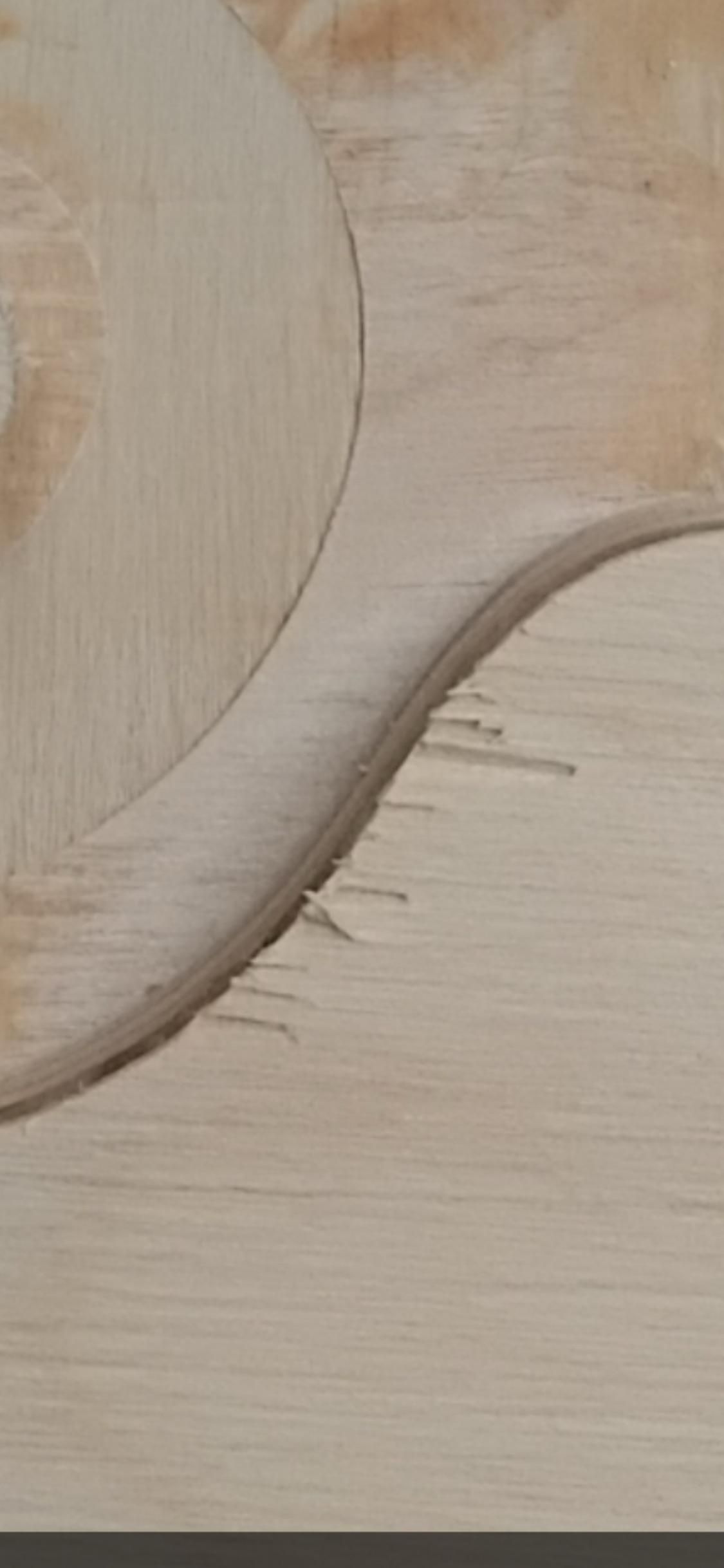
Running a batch of cut panels in 18 and 21 mm Baltic birch, and the top ply keeps splintering right where it matters most.
The artwork is tight: long sweeping curves, small islands, sharp inside corners, no straight lines to hide anything in. Pocket depth runs about 10 mm and I’m cutting with a 6 mm and a 3 mm end mill. Every panel gets painted afterwards, so any chip-out on the face is a rework and a repaint, not something I can fill and forget.
What I keep seeing is the top veneer lifting along the curved edges and blowing out around the little details. The photo is one of the worst spots.
Where I’m stuck:
- Cutter choice. Downcut, compression, or a straight two-flute for a job this fussy?
- Cutting data. Do I buy cleaner edges by slowing the feed, dropping the spindle, or going shallower per pass, or does that just burn the veneer instead?
- Strategy for the delicate bits. Is there a way to machine the small islands so the top layer stays supported until the very last cut?
- Surface prep. Does sealing or sizing the face before cutting actually help hold the veneer down, or is that one of those tricks that never works?
- Expectations. Is a clean result on this level of detail even realistic in Baltic birch, or should I be steering the customer toward a different substrate?
Anyone who has fought this, I would take the advice.