I’ve got a mountain of cabinet work coming up, so I want to put together a big-format machine that can take a whole sheet of plywood. The idea is a metal frame, square tubing with roughly 4 mm laser-cut plate, laid out along the same lines as a plasma table build I’ve been looking at for inspiration.
What I can’t settle on is the motion system for X and Y, and what feed rate to aim for. So, here is where my head is at.
Things I already own and want to reuse, left over from a high school project that never got finished:
- 2.2 kW water-cooled spindle with its VFD
- 3x 23HS9442 NEMA 23 steppers, 2.8 N·m, on DM542A drivers at 36 V
Going by the usual feeds and speeds math, cutting plywood with a 6 mm two-flute bit wants somewhere around 5,000 to 6,000 mm/min. A 10 mm two-flute clearing a pocket wants 14,000 to 16,000 mm/min.
For a machine this size I’m leaning toward an HTD5M belt, 15 mm or 20 mm wide, with the pulley mounted on the output of a planetary gearbox.
I can’t find a datasheet for these steppers anywhere, so I went looking at torque curves for other NEMA 23s of similar size and decided the torque starts dropping off around 250 rpm.
Now the numbers.
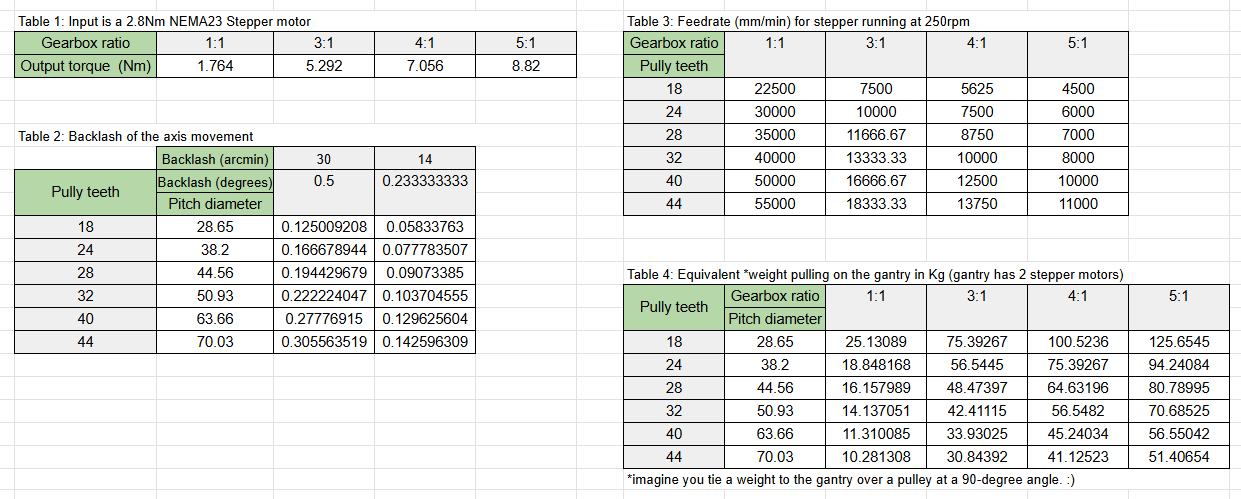
Output torque = rated holding torque x fraction of holding torque at operating speed x gearbox ratio x gearbox efficiency. I assumed 0.7 for the running torque and 0.9 for gearbox efficiency. So for a 3:1 box: 2.8 x 0.7 x 3 x 0.9 = 5.292 N·m.
Axis linear backlash = pitch diameter x pi x (gearbox backlash / 360). An 18-tooth pulley has a 28.65 mm pitch diameter, and at 0.5 degrees of gearbox backlash that works out to 28.65 x 3.14 x (0.5 / 360) = 0.125 mm.
Feed rate = (number of teeth x tooth spacing / gearbox ratio) x stepper rpm. An 18-tooth pulley on a 3:1 box at 250 rpm: (18 x 5 / 3) x 250 = 7,500 mm/min.
The last one I fully expect to get some grief over. Equivalent mass being pulled around by the gantry, in kg. The gantry carries two motors, and I worked this out just to get a feel for the force the motors actually generate: torque / pulley radius / g x 2. With a 24-tooth pulley and a 3:1 box: 5.292 / (0.0191 x 9.8) x 2 = 56.5445 kg.
That’s the whole spreadsheet. Does the logic hold up? What pulley size and gearbox ratio would you pick? I keep landing on 28T with 3:1, which gives 11,666 mm/min and about 48.4 kg of push, and that feels like a decent compromise to me.